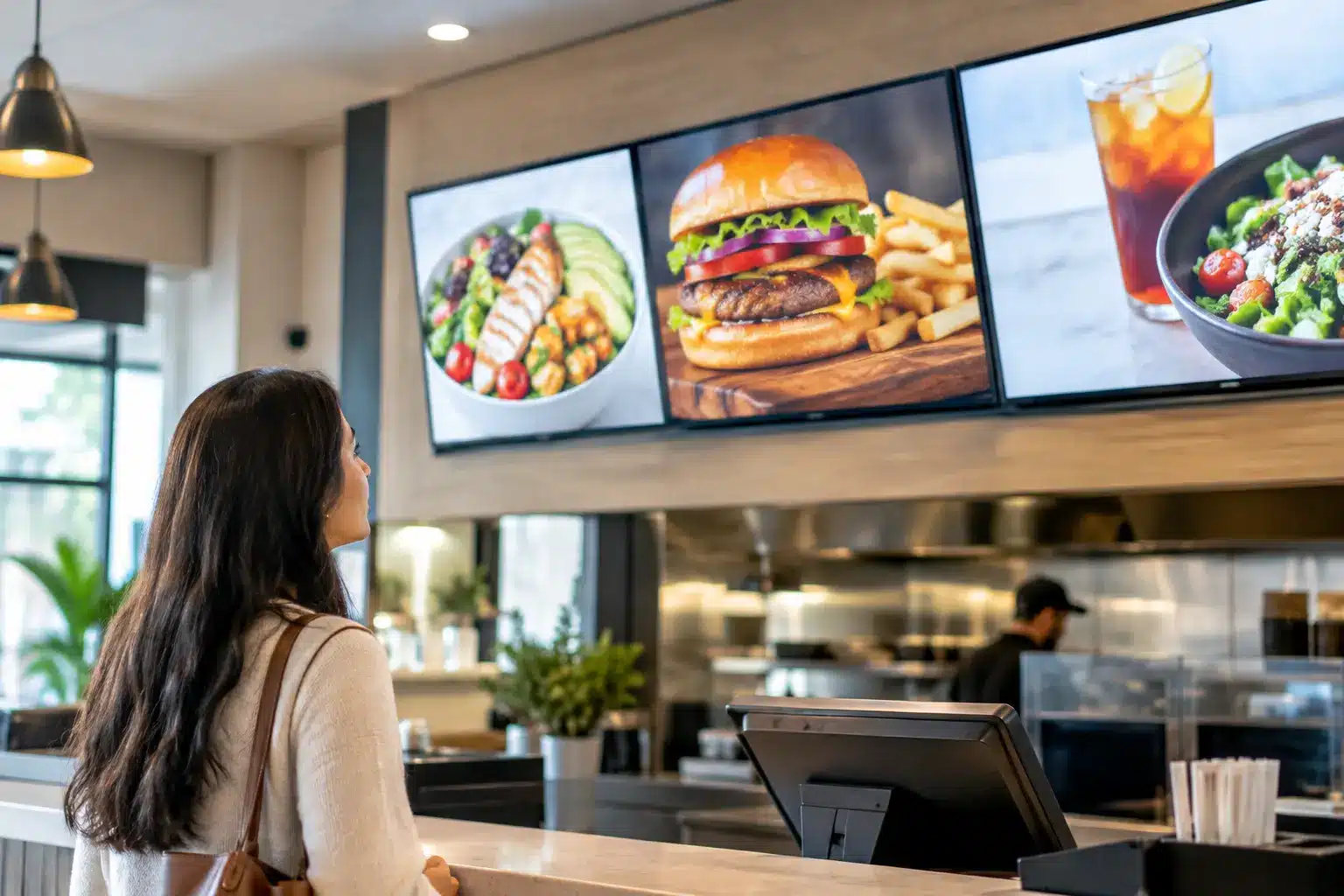

The lunch rush is not the time to discover that yesterday’s promotion is still on screen, a sold-out item is taking orders, or a new price has not reached every outlet. Restaurant digital menu boards give operators a practical way to control what customers see at the exact point where decisions are made – while reducing the daily friction of printed menu changes.
For quick-service restaurants, cafés, food courts, and multi-location F&B brands, the screen itself is only one part of the solution. The real value comes from a menu system that is readable, easy to update, correctly installed, and designed around the way customers order.
Why restaurant digital menu boards affect sales and service
A menu board has a demanding job. It must help a first-time visitor understand the offer, guide regular customers toward current promotions, communicate prices clearly, and keep the queue moving. When the menu is crowded, poorly positioned, or difficult to read, customers take longer to choose. That delay can quickly become a service issue during peak periods.
Digital boards create more control over the menu journey. Operators can schedule breakfast items to disappear when lunch begins, highlight add-ons during high-volume periods, and switch campaign visuals across selected locations without replacing printed materials. A restaurant can also respond faster when an item is unavailable or when ingredient costs require a price adjustment.
That does not mean every menu should become an animated advertisement. Too much movement, too many messages, or small text can slow decisions rather than support them. The best digital menu content is clear before it is clever: customers should be able to identify categories, key products, prices, and ordering options within a few seconds.
Better merchandising at the counter
A well-planned screen layout gives high-margin or strategically important items the visibility they deserve. A beverage upgrade, value meal, seasonal dessert, or limited-time bundle can be placed where customers naturally look while deciding.
This is particularly useful when sales priorities change throughout the day. Morning customers may respond to coffee and pastry bundles, while evening diners may need clearer visibility of sharing sets or premium add-ons. Rather than producing a new printed board for every campaign, operators can plan scheduled content for each service period.
More consistency across locations
For restaurant groups, inconsistent menus can create unnecessary problems. One branch may display an expired promotion, while another may use a different product image or price format. Centralized content management helps protect brand standards and makes campaign rollout more reliable.
The level of centralization should match the business. A single café may only need a simple, staff-friendly update process. A chain with dozens of outlets may need approved templates, user permissions, location-based playlists, and a clear process for urgent changes. The goal is not complexity. It is giving the right people control without allowing accidental changes to customer-facing content.
Designing restaurant digital menu boards for real behavior
The most effective menu boards are designed from the customer’s viewing position, not from a desktop screen. A beautiful layout can fail when it is installed too high, placed under harsh lighting, or filled with text that cannot be read from the back of the queue.
Before selecting display sizes or software, assess the service area. Where do customers stand? How far away are they when they begin reading? Is the menu viewed straight on or from an angle? Is the space bright from daylight, and does it need higher brightness to remain visible? These questions shape the technology specification and the content design.
Start with menu hierarchy
Customers should not have to scan every item before they can order. Group offerings in a familiar sequence, such as meals, individual items, beverages, and add-ons. Use the largest type for product categories and price points that matter most. Product descriptions should be short enough to support quick choices.
Photography can increase appetite appeal, but it should be selective. If every item has a large image, the board can look crowded and slow to process. Many operators get better results by using strong hero visuals for featured products and keeping standard menu sections clean and text-led.
Color also needs discipline. Brand colors should support readability, not compete with it. High contrast between the background and text is essential, especially in busy malls, transport hubs, and brightly lit food courts. A dark design can look premium, for example, but may require appropriate display brightness and lighting control to stay legible.
Choose the right display format
Standard commercial displays work well for many indoor counter applications. They provide a polished presentation and can be installed in landscape or portrait orientation, depending on the menu layout. Video walls and LED displays may be more appropriate for large flagship outlets, high-traffic food courts, or spaces where a wider visual statement is part of the brand experience.
There are trade-offs. Larger screens give more room for content, but they do not solve poor menu design. LED screens can perform strongly in bright, expansive environments, yet the viewing distance and pixel pitch must suit the location. A display built for long operating hours is generally a better operational choice than a consumer television, especially when the restaurant runs extended hours every day.
The system behind the screen matters
Restaurant digital menu boards should be considered an operating system, not a decoration project. Content software, media players, network access, screen mounting, electrical planning, and support arrangements all affect whether the solution remains reliable after launch.
A practical setup allows authorized staff to update approved content quickly, whether changes are made from a central office or at the outlet. It should also support scheduling, so the right menu appears automatically at the right time. For multi-branch brands, content can be adapted by location when availability, language, pricing, or local promotions differ.
Integration may also be relevant. Some restaurants want menu content aligned with point-of-sale data, inventory status, ordering kiosks, or queue systems. This can reduce manual work, but integration should be approached carefully. A basic digital menu network may be the right first step for a growing operator, while a complex connected environment makes more sense when the underlying systems and processes are ready.
Plan for the exceptions
Restaurant operations change quickly. Products sell out. Promotions are extended. A supplier issue affects availability. The menu board process should account for these exceptions before they happen.
Set clear ownership for content approval, publishing, and emergency updates. Keep fallback content available if a campaign asset is delayed or a network connection is interrupted. At outlet level, managers should know who to contact and what service response to expect if a screen or player requires attention.
This is where local deployment and after-sales capability can matter as much as the display specification. Installation quality affects cable safety, screen alignment, ventilation, and long-term reliability. For operators with multiple sites, a partner with trained field engineers and defined service coverage can reduce the burden on internal operations teams.
Measuring whether the investment is working
A digital menu board project should be measured against business outcomes, not just screen uptime. Start with a baseline before deployment. Depending on the restaurant format, useful measures may include average transaction value, attachment rate for drinks or sides, promotion uptake, ordering time, queue length, menu update turnaround, and printing costs avoided.
Not every uplift is caused by the screens alone. Pricing, staff recommendations, product quality, and foot traffic also affect results. However, a structured pilot can show whether clearer menu hierarchy and timed promotions are improving customer decisions. Test one change at a time where possible, such as a featured bundle placement or a different add-on message.
For a chain, the strongest case often comes from operational consistency. If headquarters can update hundreds of menu panels in minutes rather than coordinating printed materials branch by branch, the benefit extends beyond marketing. It reduces rework, supports compliance with approved pricing, and gives local teams more time to focus on service.
Building a menu board project that lasts
The right project begins with the outlet reality: menu complexity, customer traffic, viewing distance, operating hours, campaign frequency, and who will manage the content. It then brings together commercial-grade displays, suitable mounting, content planning, software control, installation, and support as one connected environment.
Arvia approaches this type of deployment as a complete visual communication solution, supported by consultation, installation, certified field engineers, and service coverage across Malaysia. With more than 4,500 completed projects and 15+ years of delivery experience, the focus is on technology that can perform in daily operations, not simply look impressive on launch day.
Before approving a screen size or content template, stand where your customers stand and try to place an order in ten seconds. That simple exercise usually reveals what the project needs most: clearer choices, stronger visibility, and a system your team can keep current without slowing down the restaurant.